Guides
6 min readUpdated
A closing repair, damaged door assembly and damaged surrounding fire separation are connected but different scopes. Identify which finding the proposed work resolves.
At a glance
- The surrounding separation and the door closure are different parts of the assessment.
- Reliable opening records help define what may be retained or repaired.
- A door repair does not establish compliance of the whole fire separation.
The repair must account for the opening's place in the barrier
A fire separation affects a commercial door repair because the door protects an opening in a wider construction assembly. Restoring a latch or closer can resolve an operating fault while leaving damage to the door assembly or surrounding separation unresolved. Identify which part is affected and what the proposed repair will restore before treating the opening as complete.
This does not mean every fault requires replacing the entire entrance or rebuilding the wall. Ontario's current Fire Code distinguishes repairs to damaged separations, repairs to damaged closures and maintenance of closure operation. Those distinctions help define a focused repair without overlooking a separate defect.
Separate the barrier, the closure and its operating components
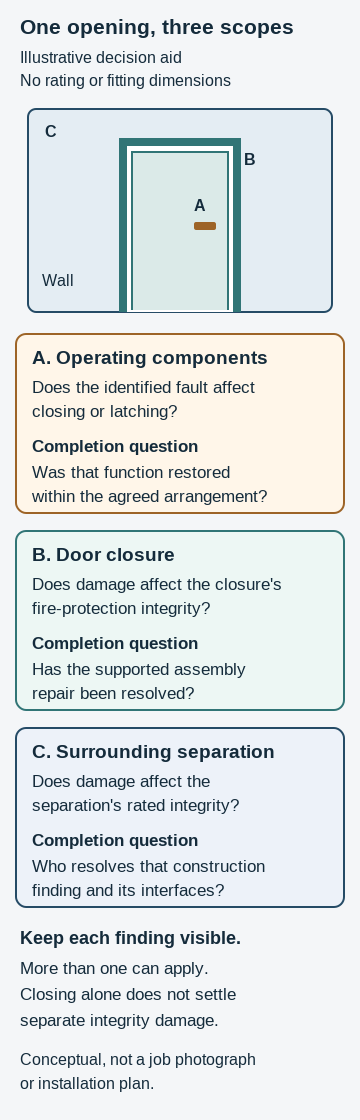
The definitions in Ontario's current Fire Code, Division A explain the relationship. A fire separation is a construction assembly acting as a barrier against fire spread. A closure protects an opening and includes its components, such as hardware, closing devices, frames and anchors. In this guide, the closure being considered is a door assembly within that separation.
That makes the moving leaf only part of the question. A closer belongs to the closure, while the closure belongs at an opening through the surrounding barrier. The word door can conceal all three scopes in a repair request.
Open the illustrative repair-scope diagram for a labelled comparison. It is a conceptual decision aid, not a job photograph, rated construction detail or installation plan. Its boxes distinguish assessment scopes; they do not prescribe materials, clearances or a repair method.
Establish the opening's actual role from the building's available plans, door schedule, fire safety information and assembly records. A door's location, weight or appearance alone does not establish the required separation or rating. Keep a missing requirement as a question for the responsible property or project contact rather than choosing a specification from a similar-looking doorway.
Three findings can require different work
The Fire Code's Division B, Section 2.2 addresses these connected findings separately:
- Surrounding separation damage: Articles 2.2.1.1 and 2.2.2.1 require repair where the specified separation damage affects the integrity of its fire-resistance rating.
- Closure damage: Article 2.2.3.1 addresses damage affecting the integrity of the closure's fire-protection rating.
- Operating faults: Article 2.2.3.2 addresses operability, including necessary hardware repairs for proper closing and latching and repair or replacement of inoperative hold-open or automatic releasing parts.
These provisions do not identify a universal repair material or decide whether an unidentified component can remain. They explain why the assessment must name the affected condition. A working latch is evidence about operation; it does not establish the condition of the frame, anchors or surrounding construction.
For commercial door repair, ask which finding supports the recommendation. If the scope expands beyond hardware, it should identify the damage or unresolved interface that creates the additional work. If it remains a component repair, the proposal should make clear whether other identified findings are being handled separately.
Compare possible outcomes without assuming one from another
Use this decision comparison for an identified door in a fire separation. These are hypothetical conditions, not descriptions of completed jobs:
- An operating fault is identified without an established integrity defect. A supported hardware repair may address the fault. The scope should explain the affected function and the completed operating checks, without describing them as proof of the entire separation's performance.
- The leaf or frame has integrity damage as well as an operating fault. Restoring movement alone leaves the damage question open. Resolve the supported closure repair or replacement alongside the hardware work. A new closer cannot supply missing or damaged construction.
- Damage extends into the surrounding separation. Door work and construction repair may need coordinated scopes. Identify who resolves the surrounding defect and how that work relates to the retained or replacement closure. Completing one scope does not automatically complete the other.
- The opening's role or an affected interface is unresolved. Obtain the missing project or assembly decision before selecting a permanent alteration. Uncertainty does not establish either that everything must be replaced or that the smallest visible repair is sufficient.
This comparison is more useful than one undivided statement that the door works. It connects each conclusion to a particular condition and keeps remaining work visible.
Include the way the door meets the surrounding construction
Ontario's Building Code Part 3, Article 3.1.8.1 distinguishes the continuous separation from protection of openings through it. The same subsection addresses closure installation. Article 3.1.8.5 also requires stops where an unrestricted door swing could damage the separation's integrity.
That last relationship matters when damage and movement meet. If assessment identifies the door striking the surrounding construction, a proposal that addresses only the damaged surface should also resolve the identified contact problem. Conversely, fitting a stop does not repair existing integrity damage. The construction finding and movement finding need their own completion decisions.
This is not a suggestion to position a stop yourself or alter the swing. The applicable project requirements and actual assembly govern the solution. Do not trim, drill, remove closing hardware or add improvised fixings to make an unfamiliar assembly operate differently. Article 2.2.3.3 of the Fire Code prohibits interference or alteration that prevents the closure's intended operation.
The separate smoke-seal and closer guide explains why return movement does not establish smoke leakage performance. The fire-glazing comparison covers glazing performance categories. Neither a closing observation nor a glass description resolves the surrounding separation's condition.
Make the completion boundary explicit
A useful agreed scope names four things together: the identified opening and its role, the particular defect, the repair and retained interfaces, and the evidence needed to close that finding. Where several providers are involved, assign the unresolved construction or assembly question rather than leaving it between their work descriptions.
For a fire rated door assessment, keep closure condition and compatible components connected to the available assembly information. A repair record should say what was repaired and checked. Do not turn a record of hardware work into a statement that the complete building's fire safety has been certified.
Toronto's Fire Prevention division conducts fire safety inspections and addresses Fire Code violations. Its role is distinct from a contractor's repair proposal. Where an inspection has identified a deficiency, keep the actual finding and any required follow-up attached to the repair scope.
If the proposal changes into replacement or alteration, resolve that actual project with Toronto Building. The City's permit guidance lists commercial door replacement within its published replacement category; it does not classify every component repair. The Toronto permit guide covers that separate enquiry. Neither an operating check nor the phrase fire door settles a permit decision.
Questions about fire separations and door repair
Does repairing the closer restore the entire fire separation?
It can address an identified closing fault. It does not, by itself, establish the integrity of the closure or surrounding construction. Keep any separately identified damage within its own repair decision.
Does damage near a fire door always mean a new door is required?
No automatic conclusion follows from proximity. Establish whether the damage affects the closure, the surrounding separation or both, then resolve an appropriate supported repair. A replacement leaf alone may not address damage outside it.
Is the frame outside the door-repair question?
The Fire Code's closure definition includes frames and anchors. Their condition and relationship to the surrounding construction can therefore belong to the assessment even when the original complaint concerns the moving leaf.
Can the surrounding surface be repaired while the door still strikes it?
The damage and the contact need separate findings. Where unrestricted swing could damage separation integrity, the cited Building Code provision addresses stops. Have the actual movement and construction solution resolved together rather than treating a surface patch as evidence that the contact problem has ended.
Does a label on the door establish the wall's rating?
A door label does not identify the whole surrounding construction or establish its condition. Use the actual building and assembly information to resolve the opening's required role. This guide does not select a rating from a label or room name.
Can a repair quotation serve as a fire inspection result?
A quotation describes proposed work. It is not the Fire Prevention division's inspection decision or proof of completed work. Keep the repair, its completion record and any authority follow-up distinct, with unresolved findings assigned to the responsible contact.