Guides
7 min readUpdated
Rust at the bottom seam needs a leaf condition assessment. A finish repair, damaged end channel and concealed deterioration are different findings, with different consequences for what can remain.
At a glance
- Visible finish rust does not reveal the condition of the entire bottom assembly.
- A door leaf, its end channel and the surrounding frame need separate consideration.
- The assessment should establish the moisture path and repair scope before a replacement decision.
Repair depends on what remains sound beneath the finish
A commercial steel door can sometimes be repaired when rust appears at its bottom seam, but the visible mark does not establish a finish-only repair or a need for complete replacement. The assessment must distinguish the coating from the steel face sheets, bottom end channel and internal construction. It must also establish what is exposing the affected area to moisture and whether the proposed work addresses that condition.
Arrange assessment before covering the seam or approving a cosmetic repair. A photograph can locate the visible change, but cannot confirm concealed steel condition, the core or the connections between components. If the edge is loose, sharp or separating, or the door cannot operate normally, keep people clear and notify the responsible property contact. Do not scrape, probe, flex or dismantle the leaf to investigate it.
Identify which bottom component is affected
The bottom seam is a location description, not a complete construction specification. Separate the moving leaf from the surrounding doorway frame and the fixed threshold. Then distinguish these parts within or attached to the leaf:
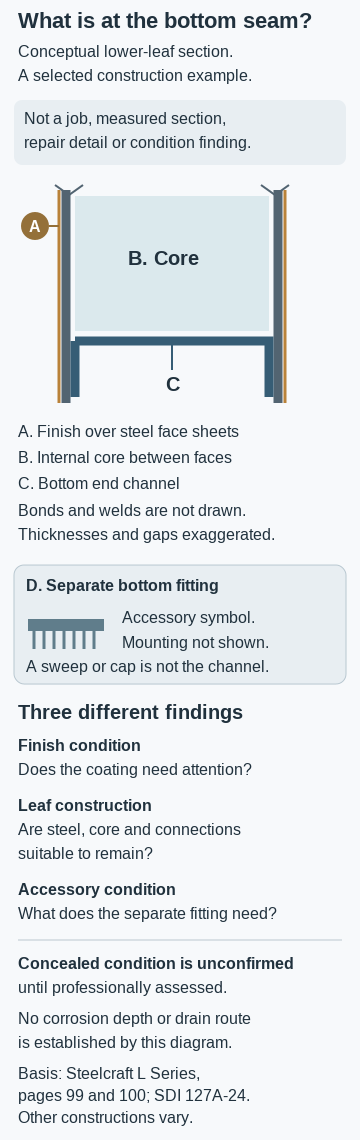
- Finish and face sheets: the protective coating and the steel skins beneath it. Damage to one does not describe the condition of everything behind it.
- End channel: a formed component closing the bottom of the leaf. Its construction and attachment belong to the door design.
- Core and internal connections: the concealed construction between the faces. Its role and materials depend on the identified door.
- Bottom cap or sealing accessory: a cap, sweep, shoe or other fitting can be separate from the underlying end channel. Name what is actually present rather than calling every strip the bottom rail.
Our conceptual bottom-of-leaf component map separates those relationships. It is an original identification aid, not a photograph, a section of your door or an installation drawing. It does not show corrosion depth or authorize opening the leaf.
The Steelcraft technical manual, L Series pages 99 and 100, provides a specific construction example: a core bonded to the face sheets and inverted end channels welded to both sheets. The manual distinguishes the end channels from optional caps. Those details explain why a bottom-edge complaint can involve more than paint; they do not identify an unknown door as an L Series product.
A finish finding and a leaf deterioration finding need different proposals
The Steel Door Institute's SDI 124 maintenance guidance calls for inspection and repair of excessive finish defects to protect against premature rusting. That is support for maintaining a suitable protective finish, not permission to conceal deteriorated door construction.
SDI's installation troubleshooting guide, section 23, describes rust appearing through water-stained paint and a finish restoration response in the specific context of improper storage. It should not be stretched into a diagnosis of an installed door's bottom seam. The useful distinction is that coating damage and deterioration of the assembled leaf are different questions.
Compare the proposed scope against the actual finding:
- A finish repair is supported: assessment establishes that the affected condition can be addressed within the appropriate coating system, with the underlying leaf construction suitable to remain. The proposal identifies that finding and the moisture or exposure issue being addressed.
- The leaf construction is affected: deterioration involves a face sheet, channel, connection or core relationship. Repainting alone does not address that finding. Any proposed repair needs a basis appropriate to the identified construction; where a suitable repair cannot be established, leaf replacement becomes the scope to consider.
- The deciding condition is concealed: the proposal names what remains unconfirmed and how professional assessment will resolve it. It does not present hidden parts as sound merely because the exterior still looks repairable.
These are decision categories, not a grading scale based on the size or colour of a rust patch. This guide supplies no universal acceptable hole, remaining thickness or repair-life allowance. A clean-looking cover cannot establish the condition beneath it, and a door that still closes has not demonstrated the integrity of its concealed construction.
Do not assume every seam or hole should be sealed
An open recess or visible hole is not enough to identify a defect or a drainage route. SDI's bottom-weep FAQ explains that manufacturers use different arrangements and that some bottom holes serve coating operations. The actual product detail must establish the purpose of a feature before anyone changes it.
Steelcraft's manual gives a particularly useful limit in its Top & bottom caps section on page 150. It distinguishes cap options and specifically warns against caulking the bottom caps described there because moisture can build up inside. That instruction belongs to those documented cap arrangements. It is neither a universal sealing detail nor evidence of the cause of rust at another door.
Ask the assessor to distinguish restoring the intended weather protection from blocking an opening simply because it is visible. Do not drill drain holes, fill a recess or seal around an unidentified bottom fitting as a trial repair. A coating proposal and a change to the door's water-management detail are separate decisions.
The SDI 127A end-channel alert also shows why an added bottom accessory is not an arbitrary cover: channel designs vary, and their geometry can conflict with hardware attachment. The proposal should account for the actual channel and supported fixing arrangement rather than assume a larger strip can be attached anywhere.
Keep the moisture question separate from the rust location
Rust near the threshold does not, by itself, prove that the threshold caused it. Record visible water, weather exposure and when the change was noticed without assigning a hidden route from the stain alone. The assessment should connect the proposed repair to the identified entry or exposure condition, including relevant seals and surrounding details.
SDI 124 treats weatherstripping and door bottoms as items to inspect separately from the finish. A replacement sweep may address a confirmed seal defect; that does not renew a deteriorated face sheet or channel. Likewise, repairing the leaf does not establish that a separate threshold or frame condition was included.
The original steel and coating specification also matters if a new leaf is proposed. SDI 112 distinguishes zinc-coated sheet from ordinary painted steel and explains coating and paint compatibility. Galvannealed describes a manufactured zinc-iron coating, not a condition that can be identified from a painted face or recreated by simply painting over rust. Match the selected material and finish to the assessed exposure without promising a service life.
Define the leaf decision without assuming a frame decision
For commercial steel door repair, a useful assessment record connects each finding to a component and consequence:
- Location: identify the affected leaf face, bottom edge or attached fitting. Record frame and threshold observations separately.
- Condition boundary: state whether the conclusion concerns finish, underlying steel, a connection or concealed construction. Distinguish observed deterioration from areas not yet assessed.
- Construction basis: identify the door and relevant channel, core and accessory detail. Include any documented fire or smoke role before alteration is proposed.
- Repair limit: name what the proposed work restores and what it leaves in place. If that depends on a later concealed-condition finding, state the decision that would change the scope.
- Exposure response: identify the moisture or protection issue addressed alongside the condition work, and any separate provider responsibility.
This record makes two apparently similar proposals comparable. Refinishing a suitable leaf, repairing identified construction damage and supplying a new leaf are different scopes. A description such as repair the rusty bottom should say which one is intended.
Where replacement is appropriate, commercial door installation concerns the new leaf's fit and supported arrangement as well as the surrounding opening. The existing frame does not automatically need replacement because the leaf is damaged, nor is frame retention confirmed by a good-looking frame face. Keep that separate condition and compatibility decision explicit.
If the work needs the existing leaf removed, the door removal scope guide explains that separate access decision. If the proposal also changes the floor, threshold or bottom clearance, use the new-flooring repair guide. Neither removal nor trimming should be assumed from the rust location.
Questions about rust at a steel door's bottom seam
Does visible rust always mean the complete door must be replaced?
The mark alone does not settle the scope. Have the finish condition distinguished from deterioration of the steel, connections and core relationship. The proposal needs evidence for a suitable repair or a stated reason that replacement is required; a photograph is not that assessment.
Can a cover plate or new sweep be treated as the rust repair?
It may address an identified accessory requirement, but covering the area does not establish that the underlying leaf is suitable to remain. Ask which condition the fitting resolves and how any damage behind it has been assessed.
Does rust at the bottom prove water entered from below?
No. The visible location does not establish the entry path. Keep the moisture investigation separate from the location record, and have the proposed protection work tied to the actual construction and findings.
Should staff clear or add holes to let the door drain?
Leave the construction untouched. A hole may have a different manufacturing purpose, and not every door has the same drainage provision. The identified manufacturer's detail must determine the intended arrangement; do not probe, drill or alter it to test a theory.
Can a labelled fire door receive the same patch as an ordinary leaf?
Do not assume the repair is transferable. Have the exact assembly information and applicable project requirements resolved for the proposed alteration. Retain identification labels. A coating repair description does not authorize cutting, welding or changing a labelled leaf.
If the leaf is replaced, can the threshold and frame stay?
They need separate condition and compatibility findings. State which components remain and which exposure or preparation issues still need work. Replacing the leaf should not silently include complete frame work or silently exclude an identified fault elsewhere.