Guides
6 min readUpdated
A turning key can change a lever state without withdrawing the latch, or movement can be lost elsewhere. Separate the intended function, mechanical response and receiving relationship before deciding on a repair.
At a glance
- A key turning does not establish that it should retract the latch on that lock function.
- Door position and the internal operating connection are separate questions.
- Describe observed movement without forcing or dismantling the lock.
A turning key does not establish that the latch has released
When a commercial door key turns but the latch does not retract, the explanation may be the lock's intended function, a problem transmitting movement through the mechanism, or binding at the door and receiving hardware. Some keys unlock a lever rather than directly withdraw the latch. If operation has changed or the door will not release, stop forcing it and arrange an assessment. Key movement alone does not identify the failed part.
First distinguish what was actually observed. A key turning while a closed door remains shut is not the same observation as seeing a latch stay extended. The latch may be concealed by the frame. Report that uncertainty rather than turn a door that did not open into a confirmed cylinder or latch diagnosis.
Establish what the key is meant to do
The useful reference is the exact lock function and the property's known normal operation. Does the key directly retract the latch, or does it change whether the outside lever can operate it? A stationary latch during an unlocking action may be expected in the second arrangement. A new loss of normal operation still needs assessment, even if a catalogue describes a similar-looking function.
For example, the operation chart in Schlage's ND-Series timing guide describes the outside key of an ND70 as locking and unlocking, while the outside key of an ND93 retracts the latch. These are named product examples, not operating instructions for an unidentified lock. Do not apply their key travel or assembly procedures to your entrance.
This function check is a starting point for interpreting a symptom. If the question is instead whether an old outside lever can remain with a replacement panic device, the outside-trim retention guide covers that compatibility decision. Here, the question is which part of an existing operating sequence has stopped producing its intended result.
Separate the input, connection and latch movement
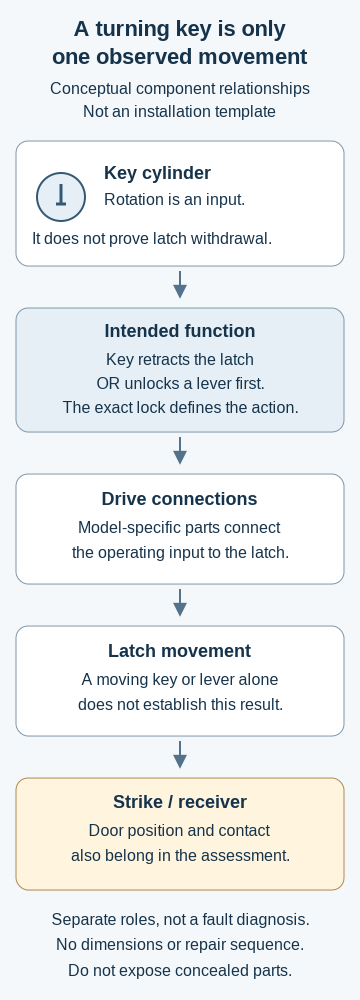
A key cylinder, the lock's connecting mechanism and the latch perform different roles. Movement at the key does not demonstrate engagement through every connection. Likewise, movement of a lever does not, on its own, demonstrate withdrawal of the latch.
Our conceptual diagram of key input, drive connections, latch and receiver separates those roles. It is an original explanation of functional relationships, not a drawing of a particular lock, an installation template or a guide to exposing concealed parts.
The BEST 9K service manual, T56082_G, page 54 illustrates why the distinction matters. For a spinning key that does not retract the latch or unlock the door, its possible causes include a missing throw member or a mismatch between the core and throw member. In a separate latch-not-retracting entry, it identifies a broken latch tailpiece or failure of that tailpiece to engage the retractor during installation. These are possibilities for that product family, not findings about your door.
The examples identify different mechanical relationships rather than one universal broken-lock diagnosis. Replacing a cylinder would not, by that action alone, establish that a separate latch connection has been corrected. A technician needs to identify the installed equipment and locate the lost movement before deciding which component work addresses it.
Keep door position in the assessment
The receiving strike and the position of the leaf matter as well as the mechanism within the door. Allegion's guidance on a cylindrical deadlatch entering the strike describes incorrect preparation or door overtravel allowing the deadlatch into the opening. It explains that this can bind latch retraction and damage the lock or latch. This is a specific receiving relationship, not proof that every reluctant key has a strike fault.
If ordinary use has already shown different behaviour with the door open and closed, tell the assessor. That difference gives the receiving relationship a place in the investigation. If the same failure was already observed with the leaf open, include that too. Neither observation identifies the damaged component by itself. Do not reproduce the fault, pull against the key, hold a glazed leaf under load or alter the strike to obtain an answer.
A door remaining shut can also leave the latch position unknown. Keep the report at that level when you cannot see more. An assessment should establish whether movement is missing inside the mechanism, whether the latch is binding at its receiver, or whether another part of the opening is preventing movement.
Compare three interpretations without ordering a part
Use the following distinctions to explain the complaint. They are assessment categories, not tests for staff to perform:
- The key changes the lever state as intended. The documented function does not require the key itself to retract the latch. Confirming the normal sequence resolves the interpretation only if the opening actually provides its intended operation. It does not excuse a new failure to release.
- An expected mechanical response is missing. An unusually unresisted key turn, a lever that no longer produces its usual result, or an already observed extended latch can help describe the missing response. The actual drive connection, latch and other components remain to be inspected. A symptom is not an order for a cylinder, tailpiece or complete lockset.
- The difficulty depends on the closed position. An already known difference between open and closed operation calls for assessment of the receiving relationship alongside the hardware. Record the difference without declaring that the frame has moved or that a new strike alone will fix it.
These categories can overlap. A receiving fault can affect the mechanism, and an altered component can leave the intended function unclear. Where the evidence is incomplete, the useful outcome is a defined inspection question rather than a confident parts recommendation.
Give the assessor a short movement record
Describe the normal result first, then the changed result. Include which side and which entrance are affected, whether the key feels different from usual, and what the lever and door did during the same ordinary use. Say whether latch movement was actually visible. If open or closed behaviour is unknown, leave it unknown.
Mention recent lock, cylinder, handle, door or frame work without treating its timing as proof of cause. Existing product records can help establish the function. Do not remove trim or a core, photograph key cuts, disconnect access equipment or collect concealed part numbers to complete the enquiry. The hardware identification guide covers the visible opening information that can support assessment.
For lock and handle replacement, ask the proposal to identify the confirmed fault and the relationship the repair will restore. If the property cannot be secured, the door that will not lock or close service is the relevant urgent securing enquiry. Describe an inability to enter separately from an inability to secure or release from inside. Follow the site's emergency procedures if safe exit is affected, and do not bypass release hardware while waiting for help.
Questions about a turning key and an unreleased latch
Does a turning key prove that the cylinder is working correctly?
It establishes that rotation occurred at the key, not that the complete cylinder and drive arrangement are correct. The intended function and the response of the connected mechanism still need confirmation.
Can the latch stay extended during normal unlocking?
Yes, in a function where the key unlocks the lever and the lever operates the latch. Confirm the actual function rather than infer it from the handle's appearance. A changed or failed entry sequence still needs assessment.
Does an unusually loose key turn mean a particular part is broken?
No. Describe the change from normal operation. Manufacturer troubleshooting can identify product-specific possibilities, but it cannot establish which one is present without identifying and inspecting the equipment.
What if the lever works from inside but the outside key does not release the door?
Report the two responses separately. They help the technician compare the operating paths, but successful operation from one side does not identify the fault on the other or confirm every exit and securing function.
Should staff open and close the door repeatedly to compare it?
No. Use differences already known from ordinary use. Do not force a resistant door or repeat a failure to create a clearer demonstration. The assessor can plan the relevant checks under controlled conditions.
Is replacing the cylinder enough to finish the repair?
That depends on the confirmed fault. The agreed work needs to restore the intended key, lever and latch response and address relevant receiving conditions. A newly turning cylinder alone is not a complete operating result.