Guides
7 min readUpdated
The inside device and outside handle are separate components with connected functions. Compare the mechanical interface, intended entry operation and preparation before deciding what can stay.
At a glance
- An outside handle and its operating function are separate from the inside push bar.
- Matching appearance does not establish a compatible mechanical interface.
- Confirm the documented trim, device and preparation before retaining components.
The outside trim can sometimes stay with a new panic device
A panic bar can sometimes be replaced while retaining the outside trim, but the proposed device must support the exact trim, intended entry function and existing door preparation. A handle that still works, a matching brand or a plate that covers the old holes does not establish that combination. Identify what the replacement will connect to before treating the outside hardware as retained.
For a planned panic bar installation or replacement, ask for the inside device and retained outside trim to be named separately in the scope. This guide explains that component decision using specific manufacturer examples. It does not identify your equipment or establish acceptance of an altered exit or fire door.
Separate the two operating sides of the door
The inside touchpad or crossbar is part of the exit device. The outside trim may include a lever, knob, pull or key-operated control. An operating trim can provide an input to the latching mechanism; a fixed pull has a different role. Keeping the outside appearance is therefore a different objective from keeping the same entry operation.
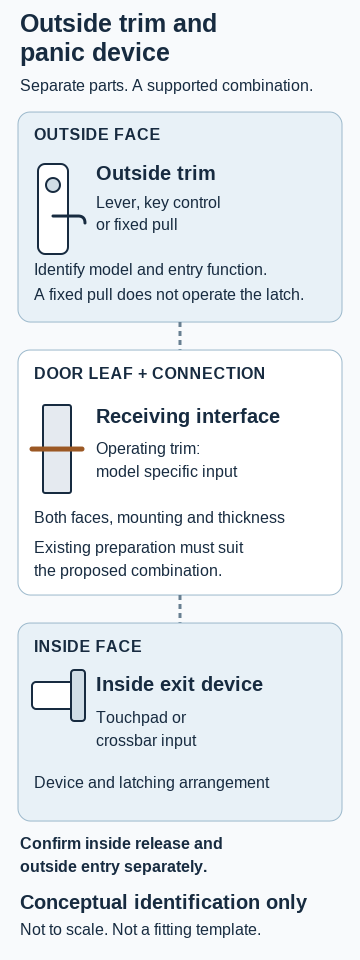
Our conceptual diagram of outside trim, the door interface and the inside device labels those relationships. It is an original component diagram, not an installation template, a drawing of your door or proof that the illustrated parts can be combined.
Keep inside release and outside entry as separate questions. A replacement that releases when the inside pad is pressed has not, on that observation alone, demonstrated the intended response to the outside key or lever. Equally, an outside access complaint does not prove that the inside device alone needs replacement.
Define the outside function before choosing the replacement
Write the required entry behaviour in ordinary language. Should the key change whether the lever can operate? Should turning the key withdraw the latch for that entry? Should the outside lever remain operable without a cylinder? These descriptions lead to different component selections, even when the handles look alike.
The Von Duprin 98/99 catalogue, 996 trim table on page 31 distinguishes 996L, whose key locks and unlocks, from 996L-NL, whose key retracts the latch bolt. It also lists 996L-BE as always operable without a cylinder and 996L-DT as dummy trim. These are functions within that named product family, not interchangeable descriptions of any commercial lever.
Use the intended function to compare proposals. A new inside device with the old keyed lever retained and a new device with a fixed outside pull are different operating arrangements. If either is proposed, the scope should explain the resulting entry behaviour rather than describe both only as a new panic bar. Do not change the existing mechanism to imitate a catalogue function while awaiting assessment.
Match the receiving mechanism as well as the trim name
A family name can contain different connections. The same 996 catalogue table distinguishes R/V trim for rim and vertical devices from M trim for mortise devices, including different cylinder types. A short description such as 996 lever leaves out information that matters to the combination being retained.
The manufacturer's 994/996L rim and vertical rod trim instructions illustrate a cylinder tailpiece and guide engaging the exit-device cam for the stated L function. Its separate 996L mortise trim instructions show the cylinder threading through the trim into the mortise lock. The receiving mechanism differs despite a similar outside lever appearance.
The useful question is therefore specific: which documented device and trim combination covers the proposed replacement, including its function and version? A shared manufacturer is a starting identity, not a cross-series compatibility statement. If the provider cannot establish the retained combination, keep trim reuse unresolved rather than order a similar-looking device and test whether it connects.
The preparation must support both faces together
The trim and the inside device share the door leaf, but they do not use an arbitrary common hole pattern. Their positions and connecting parts need to meet the applicable instructions together. A sound outside plate cannot establish the condition of the material or fixing points behind it.
For example, Von Duprin's metal-door trim template 20003_f identifies its supported R/V applications, references the device template and points to separate reinforcement guidance. It distinguishes the inside and outside faces. That is evidence that the trim preparation belongs to a defined device relationship, not permission to transfer its dimensions to an unidentified door.
Have the assessment connect the selected documents to the actual leaf construction, thickness, handing, preparation and mounting condition. Identify any necessary preparation work separately from retaining the trim. Do not remove the handle, cut a tailpiece, drill trial holes or alter the exit-device mechanism to complete a parts enquiry. The commercial hardware identification guide covers the visible information that can prepare an assessment without exposing concealed parts.
Retaining the trim does not settle the cylinder or access control
Separate the items a property wants to retain: the visible trim, its key cylinder, the existing key system and any electrical control. Agreement about one item does not establish all four. A cylinder with the right key is not automatically the cylinder type and configuration required by a different trim or receiving lock.
Electrified trim adds another operating relationship. The Von Duprin M996 data sheet describes remote locking and unlocking of its lever. It distinguishes M996L with a mechanical key override from M996L-BE without that override, and specifies R/V or mortise applications. That example concerns a controlled outside lever; it should not be reduced to a claim that any powered device can use any existing electric handle.
Where connected access remains, have the responsible provider confirm the retained trim, intended locked and unlocked behaviour, power-loss function and key provision for the selected arrangement. The scope should identify who checks that relationship after the device work. Staff should not disconnect wiring or change control settings to keep a proposed mechanical replacement working.
Compare three outcomes for the retained outside hardware
Use these outcomes to distinguish a supported smaller change from a different operating arrangement:
- Retain the complete outside trim assembly. The documented device match, entry function, preparation and condition have been confirmed. State the trim and cylinder that remain, along with any connecting parts included in the replacement work.
- Retain selected outside items. The visible trim may remain while a specific compatible component changes, or a new trim may be selected while an authorized key-system arrangement is retained where supported. Name the retained items individually; do not use same key to imply same cylinder or same trim.
- Replace the device and trim as a matched proposal. An identified incompatibility, unsuitable condition or changed function prevents the proposed trim reuse. Explain that reason and the receiving preparation. A matched hardware proposal does not, by itself, mean the door leaf or frame must also be replaced.
Keep an unconfirmed connection separate from a confirmed need for replacement. If assessment has not yet established a concealed part or mounting condition, say which finding will decide the scope. This is more useful than either promising all outside hardware will stay or replacing it merely because the inside device is changing.
For lock and handle replacement, distinguish the requested keying or lever function from the exit-device work. Where the difficulty is supply rather than the interface, the unavailable commercial hardware guide compares sourcing, retrofit and wider replacement. Here, the retained-trim decision is complete only when the proposed combination and its operating result are established.
Questions about retaining outside trim
Does staying with the same brand establish compatibility?
No. Confirm the device series, trim version, function and application together. The R/V and mortise distinctions in the 996 example show why a familiar trim family name can still leave the receiving connection unresolved.
If the outside handle works, can it automatically stay?
Its observed operation is useful condition information, but it does not establish a match with a new inside device. The assessment must address the proposed combination and determine whether retaining the trim suits the actual fault and preparation.
Can the existing key be kept even if the trim changes?
That is a separate key-system question. Have the provider confirm authorization and the supported cylinder arrangement for the selected trim and device. Keeping the key does not automatically mean retaining the same cylinder.
Does successful inside release prove the outside trim is correct?
No. The agreed outside key, lever or access-control response needs its own confirmation, alongside inside release and the return to the intended securing state. A demonstration of one input does not establish the other operating functions.
Does a fire exit device use the same retained-trim decision?
The proposed combination must be checked for the exact fire-exit version and identified assembly requirements. A catalogue's supported combination is product evidence, not a local approval of your door. Do not extend a statement about a panic version to a different fire-exit configuration without the relevant documentation.
Does replacing the trim mean replacing the entire door?
No automatic conclusion follows. Ask whether the limit concerns the hardware interface, function, mounting condition or the leaf itself. A new matched device and trim may be a different scope from replacing the leaf or frame; the proposal should identify any wider work and its reason.