Guides
7 min readUpdated
Vertical rods carry the latching arrangement to the head and, in many configurations, the bottom of the opening. Rim devices latch at the door edge. That changes the receiving hardware and the options for a pair.
At a glance
- Rim and vertical rod devices secure different points around the opening.
- The visible push bar does not identify the complete latching arrangement.
- Match the device, receiving points and documented opening requirements together.
The difference is where the door latches
Some exit doors use vertical rod devices because the opening calls for latching at the head and, in many configurations, at the bottom, rather than a rim latch engaging a receiver beside the door edge. On a pair, that can provide a supported arrangement without the central strike-carrying mullion used by a two-rim-device layout. The intended passage, door construction, meeting edges and documented hardware configuration determine which arrangement suits the opening.
Neither type is universally better. A similar horizontal pushpad can operate different latching systems, and vertical rod devices can also be used on single doors. Before choosing a replacement, compare the complete latching arrangement rather than the appearance of the bar. If an exit is not releasing normally, follow the property's procedures for a compromised exit and arrange assessment. Do not disconnect rods, remove receivers or hold latches out of engagement to keep it in use.
Compare the pushpad, latch and strike separately
The pushpad is the part a person presses. The latch is the moving part that secures the leaf. The strike is the receiving component that the latch engages. The device and its linkage connect the operating action to the latching points. Knowing where the latch meets its strike explains more about the arrangement than the pushpad's shape does.
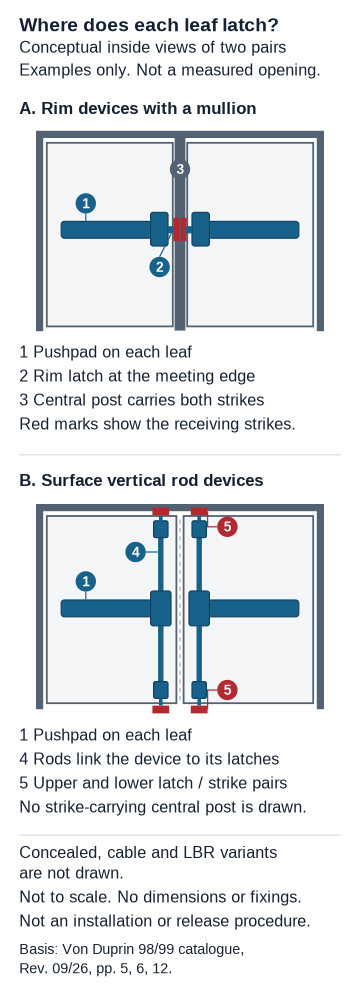
Our conceptual rim and vertical rod diagram compares two paired layouts from the inside. It labels the pushpads, rim latch locations, central mullion, vertical rods and upper and lower receiving points. It is an original illustration of relationships, not a site photograph, product template or installation plan. It shows a conventional top-and-bottom surface rod example; concealed and less-bottom-rod variants are not drawn.
The comparison is based on the application drawings in Von Duprin's 98/99 Series catalogue, September 2026, page 5. They show two rim devices with a mullion, two surface vertical rod devices, concealed arrangements and other combinations. These are identified manufacturer applications, not interchangeable layouts for every existing pair.
A rim pair needs its central receiving arrangement explained
In the catalogue's two-rim-device layout, each leaf's latch engages a strike carried by the central mullion. The mullion is the post between the leaves. It supplies a receiving location where there would otherwise be the meeting gap between two moving panels. The single-door rim example instead has its receiving location at the side frame.
That central post matters when a property wants occasional wider access. Opening both leaves does not remove the post from the passage. The catalogue's Mullions section, page 73, describes removable and keyed removable products for appropriate rim-device pairs. A supported removable-mullion arrangement can address a different access objective from a permanently unobstructed centre.
This is a selection question, not advice to remove a post. Establish whether an existing member is a removable hardware mullion, which system it belongs to and how the opening must be restored for normal use. Do not assume that a central frame member is removable because a different manufacturer's drawing shows a removable mullion.
Vertical rods move the receiving points away from the meeting gap
The surface vertical rod example uses rods on the door face between the main device and the upper and lower latches. The corresponding strikes are at the head and the lower receiving location. The catalogue's 9827/9927 section, page 12, identifies those top and bottom components and alternative bottom strikes, including a threshold application.
For a suitable pair, this arrangement avoids relying on the central post shown in the two-rim-device example. It does not eliminate receiving hardware: it relocates the latching relationships. The head, lower receiver and door preparation therefore become part of the comparison. The 98/9927 manufacturer instructions show separate preparation for the device, latches, rods and strikes. No preparation dimensions or procedures from that document should be copied to an unidentified door.
Surface rods also occupy exposed positions on the leaf. Von Duprin describes guards for the bottom rod and latch where carts or gurneys could strike them. That makes the movement of equipment a relevant use condition to discuss. It does not establish that every rod device needs a guard, that concealed hardware is automatically preferable, or that one arrangement has a longer service life.
Concealed rods and absent bottom rods need different explanations
Concealed vertical rods run within a prepared door rather than visibly along its face. The catalogue identifies its 9847/9947 concealed rod devices separately from the surface version. It also lists concealed cable devices as a different device type. A clean door face is therefore insufficient evidence of a rim mechanism, and a concealed rod system should not be called a cable system without identification.
Less bottom rod, often abbreviated LBR, is a documented option on particular devices. It is not permission to remove a bottom rod from an arbitrary installation. The catalogue includes fire-exit LBR arrangements with an auxiliary fire latch, and Allegion's LBR/LBL guidance specifies different supporting kits for identified surface and concealed applications.
The useful conclusion is limited: a missing visible bottom rod may reflect a supported variant, concealed hardware or an unresolved condition. Its appearance alone does not establish which. Have the actual model, option and assembly documentation confirmed. Do not add, detach or adjust a rod to make the opening resemble the diagram.
Compare the proposed arrangement at three boundaries
Use this original comparison to read a proposal. It concerns relationships, rather than a list of parts to order:
- Receiver boundary: where does each leaf latch now, and where would it latch after the change? Identify a side-frame strike, mullion strike or upper and lower receiving arrangement. A proposal to change device type must explain the receiving side as well as the new pushpad.
- Passage boundary: must the centre remain clear during ordinary use, or is wider access an occasional separate operation? Compare the actual proposed condition with the central post present or absent. Do not use the sum of the two leaf widths as proof of available passage.
- Assembly boundary: which door preparation, meeting detail and documented performance must the selected arrangement preserve? Keep an unverified concealed component or label identified as unresolved, rather than filling the gap with a catalogue resemblance.
For example, retaining a supported rim pair and its mullion is a different proposal from replacing both devices with a supported vertical arrangement. The second proposal changes the latching locations and associated preparation; it is more than exchanging two bars. Conversely, a request for occasional equipment access does not automatically require conversion to rods if a suitable removable-mullion system is part of the assessed alternative.
Meeting edges can limit the comparison. Page 5 of the Von Duprin catalogue expressly excludes overlapping astragals from its marked two-surface-rod, LBR and concealed vertical examples. That restriction belongs to those illustrated applications. It is a reason to check the actual meeting detail, not a blanket statement that every vertical device is incompatible with every astragal.
Keep selection separate from fault finding and project approval
A stuck latch does not establish that the device type was the wrong choice. Have the installed arrangement and operating complaint assessed through commercial door repair. The hardware identification guide covers the opening record and visible product information without dismantling equipment. This comparison explains what changes when the latching arrangement changes; it does not diagnose rod adjustment or prescribe a release test.
For panic hardware installation, have the proposal identify the intended device arrangement and its supported receiving components. Any documented fire or exit role belongs in that selection. Manufacturer examples do not establish the Ontario requirements for an unidentified building, and this guide supplies no occupancy threshold, universal panic-hardware requirement or approval to alter a rated assembly.
Outside trim retention and the securing of an inactive leaf are separate component decisions. A vertical rod arrangement is not interchangeable with an independently operated flush bolt just because both involve upper or lower receiving points. Where power operation is proposed, the paired operator guide covers the separate request, release, movement and return sequence. Keep that sequence connected to the selected latching arrangement.
Questions about rim and vertical rod exit devices
Are vertical rods only used on double doors?
No. The current Von Duprin catalogue lists its surface and concealed vertical rod examples for single as well as paired applications, within their stated product limits. The number of leaves alone does not select the device.
Does a rim device always require a centre post?
No. A single-door rim arrangement receives the latch at the side frame. The two-rim-device pair illustrated here uses a central mullion. Do not extend that particular paired example into a rule for every rim application.
If there are no visible rods, must the device be rim hardware?
No. Rods or cables can be concealed within a prepared leaf. Confirm the identified product and latching arrangement instead of choosing from the appearance of the horizontal bar.
Does an absent bottom rod mean the device is incomplete?
Not necessarily. Specific documented LBR configurations exist, including arrangements with additional fire-related components. Appearance alone cannot distinguish a supported option from a missing part. Leave that determination to the identified assembly assessment.
Can vertical rods be replaced with rim devices using the same holes?
Do not assume so. The latching locations, receivers and preparation change. A pair may need a different central receiving arrangement. The proposal must account for those interfaces, rather than only whether a new bar covers old holes.
Which arrangement is better for moving large equipment?
Compare the actual passage required and the supported opening in that condition. A suitable vertical arrangement can avoid a central strike-carrying post, while an appropriate removable-mullion rim system can provide a separate wider-access option. Neither description establishes that the existing opening supports the change or that its hardware may be left out of service.