
Colin Tooke

“Great experience from start to finish. Called at 7am on a Sunday about a broken door closer and was all fixed before 10:30am same day. Customer service was friendly and prompt. Very professional , would highly recommend their services.”
Open
Automatic entrances · 24/7 service
Automatic door repair and automatic door opener repair start with the complete entrance. A fault can involve the door, operator, activation device or connected lock. We assess the operating sequence before recommending the repair.
Leave your details and get $50 off your first repair.
Original customer reviews
Colin Tooke
“Great experience from start to finish. Called at 7am on a Sunday about a broken door closer and was all fixed before 10:30am same day. Customer service was friendly and prompt. Very professional , would highly recommend their services.”
Marshall Berenbaum
“Quick and relatively painless window replacement, Dekel was communicative and knowledgeable. Highly recommend.”
Wondraw
“Great service which fixed my malfunctioning sliding patio door lock. They were able to reduce their original quoted price which made the service more reasonable. The tech was courteous and knowledgeable, but had to return on a separate day due to an incompatible lock mechanism. He visited the very next morning and completed the repair quickly. Thanks for all your help! Highly recommend- 5 stars!”
Javier Solis
“I'm in scarborough they came complete the job, Very friendly and professional; everything was very clean. Excellent work.”
Automatic door operator repair starts by identifying the door system and observing what fails. A powered swing door uses an operator and arm arrangement to move a hinged leaf. An automatic sliding entrance has a different drive and supporting assembly. An activation button failing to respond is not the same fault as a door binding in its frame, even if both leave the entrance closed. The assessment should establish the door type, equipment and operating sequence before a component is selected for replacement.
Tell us whether the entrance does not respond, starts and stops, moves unpredictably or fails to close and secure. Describe any change in noise, movement or frequency. An intermittent problem can be difficult to reproduce, so a clear account of when it occurs is useful. Call our 24/7 line to discuss the entrance and access arrangements. Door N Window is insured and WSIB Covered, with same-day service available. We confirm the proposed scope after assessment rather than diagnosing the entire system from one symptom.
If the door moves unexpectedly, strikes an obstruction or cannot provide safe passage, keep people clear and arrange an assessment. The property manager should establish an appropriate alternative access arrangement. Do not bypass safety devices, increase force to overcome a fault or repeatedly activate an entrance that is behaving unpredictably. A door held open or switched to another mode is not evidence that its operating fault has been repaired. Required exits and accessible entry arrangements also need consideration by the responsible property contact.
Follow the actual installed system’s occupier instructions when managing its mode. Keep any failed routine-check result available. Observation differs from opening covers, adjusting controls or working on electrical connections; those belong within the agreed service scope.
Provide the property address, the entrance affected and the person authorized to approve work. A photo of the complete doorway, operator housing and visible model label can help prepare the visit. Include the activation devices and connected locking hardware if they can be photographed safely. Do not dismantle the operator to find a label. Tell us about property-management access, keys or security procedures, and whether the fault affects one door, a pair or a vestibule containing more than one powered opening.
Describe recent changes such as a replacement lock, a new access-control connection, construction beside the entrance or altered flooring. These details can explain why an operator fault appeared without proving that the operator itself has failed. If a display shows a fault indication, record what is visible without sharing access-control passwords or changing settings. A brief record of the conditions and symptom is often more useful than repeated attempts to reset the system before the technician can see it.
The powered system depends on a door that can move through its intended path. A swing leaf rubbing on the threshold, worn hinges or loose pivots can add resistance or change the arm geometry. Frame movement, damaged seals and a latch catching its strike can also interfere with operation. The inspection considers those mechanical conditions as well as the operator. Increasing a drive setting without addressing physical resistance can leave the underlying fault in place.
On a sliding system, the supporting arrangement, guides, track area and panel movement need inspection. Debris, damaged guides or worn support components can produce uneven motion or noise. The technician examines the actual system rather than assuming a generic roller or belt will fit. Commercial door repair may be part of the scope when the leaf, frame or hardware is responsible for the difficulty. The operator and doorway should be treated as connected equipment, with the source of resistance identified.
Activation can originate at a push plate, touchless device, approach sensor or connected system. Identify the affected point and any working alternatives. The assessment follows the input and response rather than treating a device light as proof of the complete signal path.
Report intermittent conditions such as busy periods or weather. Wired and wireless devices need their actual connections and compatibility considered. Do not strike a button harder or relocate detection equipment as a troubleshooting experiment.
Safety and activation functions must be understood separately even when their equipment looks similar. Depending on the installed system, detection can influence whether the door opens, remains open or moves during a cycle. Dirt, damage, changed surroundings, a device fault or its settings may affect the response. The equipment and manufacturer's instructions determine the appropriate checks. A door opening when nobody is approaching does not, by itself, identify which device or part needs replacement.
Describe furniture, signs, displays or other objects recently moved near the doorway. These can be relevant to the environment being assessed, but moving them is not a substitute for service when the door behaves unsafely. Do not cover detection devices or bypass them to keep the business entrance running. The service plan needs to establish the cause and verify the repaired system's response. We do not describe a safety-device replacement as complete until the relevant door operation has also been considered.
An entrance that responds to its interior push plate but not the exterior device gives a different starting point from one that receives no working command. Tell us which activation point was involved when the symptom occurred, the operating mode visible at that time and what the door actually did. A lit device, a relay sound or movement beginning does not confirm the full cycle. The assessment should distinguish the activation input from lock release, powered travel, detection response and return to the intended secured state.
These observations are for reporting an existing symptom, not instructions to repeatedly test an unsafe entrance. Do not disconnect a sensor, move wiring or change control parameters to isolate a theory. Follow the installed equipment's occupier instructions and keep any failed routine-check result available. If the fault is limited to a particular device, the automatic door button repair guide covers that focused enquiry. A combined or uncertain sequence remains part of the complete operator assessment.
If an entrance works once after a reset but later fails again, record that pattern and the circumstances already observed. One successful activation does not establish that an intermittent fault has been resolved. The service record should identify the affected opening, installed equipment, fault addressed and relevant checks performed. Where a component, another provider or further observation remains outstanding, state that dependency and any operating restriction explicitly. Replacing a part and confirming the intended entrance sequence are separate steps in an understandable repair handover.
For a swing entrance, the operator housing, arm, attachments and relationship to the leaf are part of the inspection. Loose mounting, wear or damage can affect movement and transfer loads into the door or frame. A replacement arm needs to suit the operator, application and opening. The technician checks the support before agreeing the repair, rather than assuming that tightening an attachment resolves every fault. A damaged fixing point can require work beyond the arm itself.
Powered sliding components must match the installed system. Noise or uneven motion can involve mechanical resistance as well as worn parts. Explain outstanding identification, supply or further work so a partial intervention is not presented as restored automatic operation.
A powered door connected to an electric lock must coordinate release and movement. If the leaf tries to move before a lock releases, the symptom can resemble an operator struggling against resistance. If the entrance moves but cannot secure afterward, the locking or alignment stage also needs investigation. We consider the sequence and establish which parts of the work fall within the door repair scope. The property's access-control or electrical provider may need to participate.
Identify the authorized provider managing the reader, lock and controller, including recent changes. Do not send passwords or alter wiring. The handover must state any unresolved locking mode or coordination, rather than infer complete operation from one successful command.
Two powered doors serving one entrance can have coordinated movement or separate controls. A vestibule may contain an outer and inner door with activation points arranged for people moving in each direction. Report which opening fails and whether the other one responds normally. The assessment considers the actual sequence and devices, rather than treating a pair as one interchangeable operator. Faults on one opening can affect the experience of entering or leaving even when the second door is working.
Record the current supported operating mode and follow the supplied instructions. Do not change modes to conceal unpredictable movement. After repair, check the relevant activation points and intended modes, and explain normal operation and any remaining restrictions to the responsible contact.
The assessed fault may call for mechanical correction, activation repair, compatible parts or operator replacement. We agree findings and scope before paid work. Parts availability or another provider’s involvement may leave a further stage; a generic replacement is not automatically suitable.
At handover, establish which fault was addressed, what operating checks were completed and whether any restrictions remain. Staff should have the instructions relevant to their equipment and know which changes or failed checks require another service call. A related door closer or exit-hardware problem should not be mistaken for an automatic-drive repair. If the concern is a damaged glazed opening alongside the system, storefront glass replacement may be a separate part of the repair plan.
For a practical way to record intermittent symptoms and pass the repair status between shifts, use our automatic door fault report and handover guide. It explains what to keep with the opening record before and after the visit.
For a powered pedestrian sliding opening, our automatic sliding door repair guide explains panel suspension, guidance, drive and detection assessment. Manual patio roller repairs belong to a different service. Identify the whole entrance and the observed movement before assuming the same hardware or repair will fit both systems.
When only one push plate, touchless switch or wireless control fails, describe that specific activation point. Our automatic door button repair guide explains the device, mounting, receiver and connection assessment. The complete operator guide remains the starting point for uncertain or combined entrance faults.
Boris Stoikos's saved review excerpt mentions an issue with an automatic door opener. The missing remainder is not available in the saved source and has not been written in. Colin Tooke's separate excerpt concerns a broken door closer. That is related entrance-hardware evidence, not an automatic operator repair case. Both original excerpts and their individual ratings are shown below without changing the wording or using them to promise the outcome of another job.
For planning beyond an individual component fault, our automatic door accessibility planning guide explains the approach, activation, complete entrance and relevant project requirements. It helps prepare an assessment without treating one repaired part or installed operator as proof of whole-building compliance.
 Originally posted on Google
5 / 5 stars
“Great experience from start to finish. Called at 7am on a Sunday about a broken door closer and was all fixed before 10:30am same day. Customer service was friendly and prompt. Very professional , would highly recommend their services.”
Customer reviews
An automatic opener review comes first, followed by related closer and commercial exit-door repairs, then more customer reviews. Open a review for the original feedback and photos.
Colin Tooke
Originally posted on Google“Great experience from start to finish. Called at 7am on a Sunday about a broken door closer and was all fixed before 10:30am same day. Customer service was friendly and prompt. Very professional , would highly recommend their services.”
Marshall Berenbaum
Originally posted on Google“Quick and relatively painless window replacement, Dekel was communicative and knowledgeable. Highly recommend.”
Wondraw
Originally posted on Google“Great service which fixed my malfunctioning sliding patio door lock. They were able to reduce their original quoted price which made the service more reasonable. The tech was courteous and knowledgeable, but had to return on a separate day due to an incompatible lock mechanism. He visited the very next morning and completed the repair quickly. Thanks for all your help! Highly recommend- 5 stars!”
Javier Solis
Originally posted on Google“I'm in scarborough they came complete the job, Very friendly and professional; everything was very clean. Excellent work.”
Open a review to read the original customer feedback.
Read more customer reviews






















Work at these locations includes jobs through facilities contractors. Logos belong to their owners; no affiliation, sponsorship or endorsement is implied.
This service
Repairs, replacements and the right next step for your property.
We diagnose on site and quote before proceeding. Operator brand and age, whether sensors or controller boards have to be ordered, header access and lift requirements, and emergency attendance outside business hours all affect the cost.
We assess the opening, measurements and work needed before preparing a quote. Call or leave your details to discuss a visit.
The work
We assess the power, controls, activation and safety sensors, then the door's mechanical movement. Similar symptoms can have different causes. We identify the fault on site and explain the repair options before paid work begins.
Header-mounted motion and presence sensors drift out of alignment, collect dust, and get confused by rain, sunlight and moving signage. We clean, realign and re-range them, replace failed units, and re-test the detection field across the full opening. Push plates, touchless switches, mats and card interfaces are tested and replaced as needed.
Sliding doors run on carriage rollers along a header track with a belt drive. Worn rollers, a stretched or slipping belt, a seized idler pulley or debris in the bottom guide all show up as juddering, slow travel or a door that stops short. Parts are replaced and the door is re-taught to the controller.
Low-energy swing operators fail at the gearbox, the arm assembly and the spring pack, usually after being forced by wind or by someone pushing the door manually. We rebuild or replace the drive, reset opening and closing speeds and hold-open time, and check the door still opens manually with reasonable force when the power is off.
Before we leave, the door is cycled repeatedly with the detection fields checked across the opening, the reopen function tested against an obstruction, and the speeds and hold-open time set so the door does not catch anyone. Break-out function on sliding doors is tested and reset if the panels have been pushed out.
A closer look
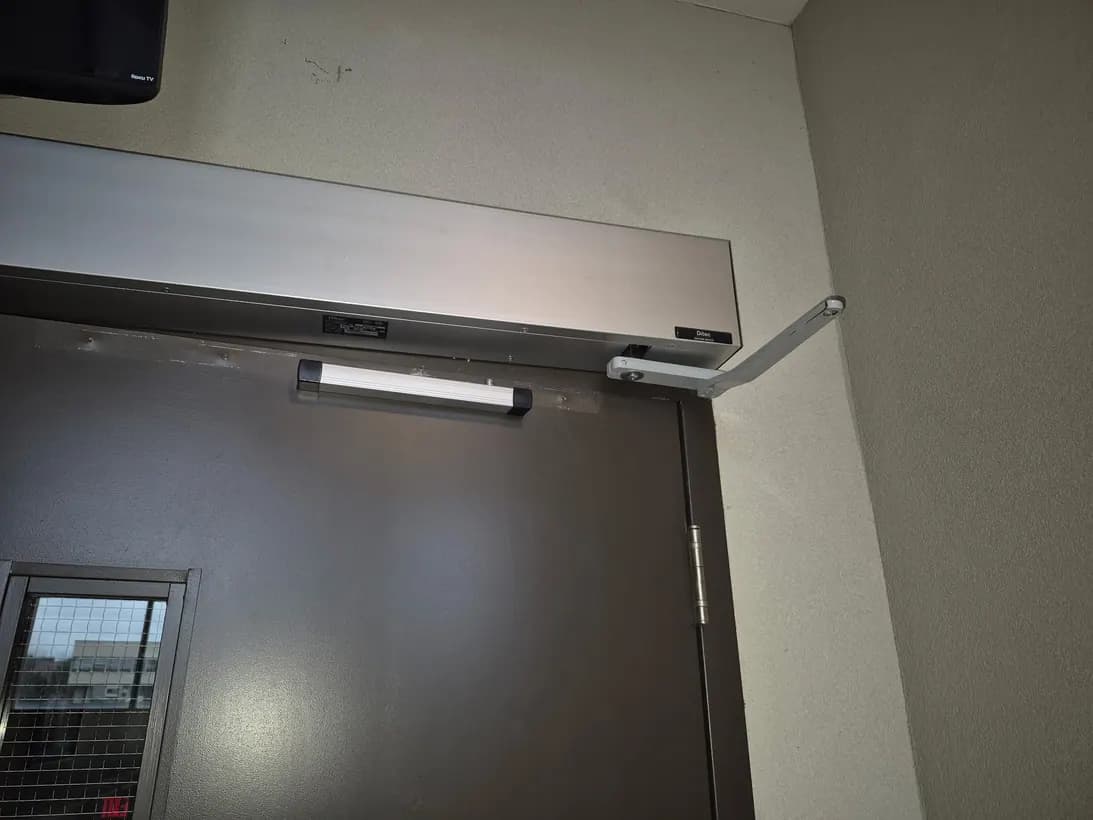
The operator housing, drive arm and door support photographed at an existing entrance.
Read project descriptions and original customer feedback about door, window and glass work.
View project descriptionsExplore repair options for doors, windows and glass. Explore our services.
How it works
Call or send the details. Photos are helpful, but optional.
We assess the job on site. You approve the price before paid work starts.
We secure unsafe openings and arrange the agreed repair or installation.
An itemised invoice describing the work.
Door, window and glass work for homes and businesses. Insured, WSIB Covered and available 24/7.
Insurance claims
After a break-in or property damage, we help with paperwork describing the damage and repair.
Coverage and reimbursement depend on your policy and your insurer's approval.
How we help with your claimService areas
Residential and commercial service across Toronto, Peel, York, Durham and Halton, plus Hamilton, Barrie and nearby communities.
FAQ
If yours is not here, call and ask. We would rather answer it now than have you guess.
We assess automatic swing and sliding door systems, their operating hardware and activation. Identify the system and describe the symptom when calling. The actual model, condition and connected equipment determine the proposed scope and any parts or coordination required. We do not assume identical components fit different entrances.
No. The activation device, connection, operating mode or another part of the sequence can be involved. Tell us whether other activation points still work. The assessment follows the signal and door response rather than replacing the operator solely because one button fails to open the entrance.
Keep people clear, arrange an assessment and have the responsible property contact establish suitable alternative access. Follow the supplied equipment instructions for managing its mode. Do not bypass detection devices, increase force or repeatedly test unsafe movement. Required exits and accessible entry also need consideration.
Yes, mechanical resistance can affect a powered entrance. The leaf, support, frame, seals and latch interaction need inspection alongside the drive. Increasing an operator setting does not correct damaged support or binding. The repair plan should identify the source of resistance and the equipment affected.
A visible model label or a safe photograph can help prepare for the visit, but do not dismantle equipment to obtain it. Send the whole opening, operator housing and affected activation device where practical. The technician still needs to assess the actual installation and fault on site.
A lock-release or sequencing issue can affect operation, particularly when the operator tries to move a locked leaf. The door and controls need coordinated assessment. Tell us who manages the access-control equipment so any electrical or security-provider work can be identified and arranged within the agreed scope.
Record the symptom, visible fault indication and operating conditions first. Follow the supplied instructions rather than repeatedly changing modes or settings. Unrecorded changes can make an intermittent fault harder to reproduce. Do not open covers, change wiring or bypass equipment as a troubleshooting experiment.
Replacement may be an option after the opening and equipment are assessed. Door construction, support, activation, locking and intended use influence the proposed system. We discuss the alternatives and agreed scope. An unavailable part does not establish that a generic replacement will suit the entrance.
We are available 24/7 and same-day service is available. Call with the location, entrance type and current condition to discuss the next step. Safe access, assessment, compatible parts and any coordination affect the work. There is no fixed arrival or completion promise attached to the enquiry.
Checks depend on the installed system and agreed repair. They should consider the affected activation points, intended movement, detection functions and any connected locking sequence. The handover identifies completed work, equipment instructions and remaining restrictions or coordination. A temporary mode change should not be presented as a completed permanent repair.
Related services
Call and describe it, or send the details through the form.